
Beyond the Logo: Building a Cinematic Opening Sequence
Project Overview:
STUDIO:
Emberhouse Media Group
PROJECT:
Westworld-Inspired Cinematic Brand Intro
RUNTIME:
67 Seconds
SERVICES:
Creative Development • Visual Direction
AI-Assisted Animation • Editing • Color
Music Development
A logo can appear on screen in two seconds. We wanted to see what would happen if we gave it 67.
Inspired by the cinematic opening titles of HBO's Westworld, Emberhouse Media Group set out to create an elaborate title sequence centered around its own visual identity.
Rather than relying on traditional logo animation, the concept explored an entire mechanical world where robotic hands, intricate machinery, and molten copper gradually bring the Emberhouse identity to life.
The resulting film became an exploration of cinematic storytelling, visual development, and the creative possibilities of emerging production technology.
The Opportunity:
What if a brand introduction could feel more like the opening of a prestige television series than a traditional corporate logo reveal?
Opening title sequences have a unique ability to establish tone, emotion, and visual identity before a story even begins.
We wanted to explore that same approach with Emberhouse.
The challenge was to develop a series of visually connected scenes that could stand on their own while contributing to a larger narrative.
Instead of simply revealing the finished logo, the film would show its creation through a world of precision machinery, copper materials, and mechanical movement.
The objective wasn't necessarily to create the most efficient way to introduce a company.
It was to explore how much visual storytelling could exist within something as simple as a logo reveal.
Our Approach:
We approached the project as a cinematic production rather than a conventional motion graphics exercise.
The process began with establishing a consistent visual language.
White robotic machinery, polished metallic surfaces, deep black environments, and warm copper highlights created the foundation for the sequence.
From there, individual scenes were developed around the idea of construction and transformation.
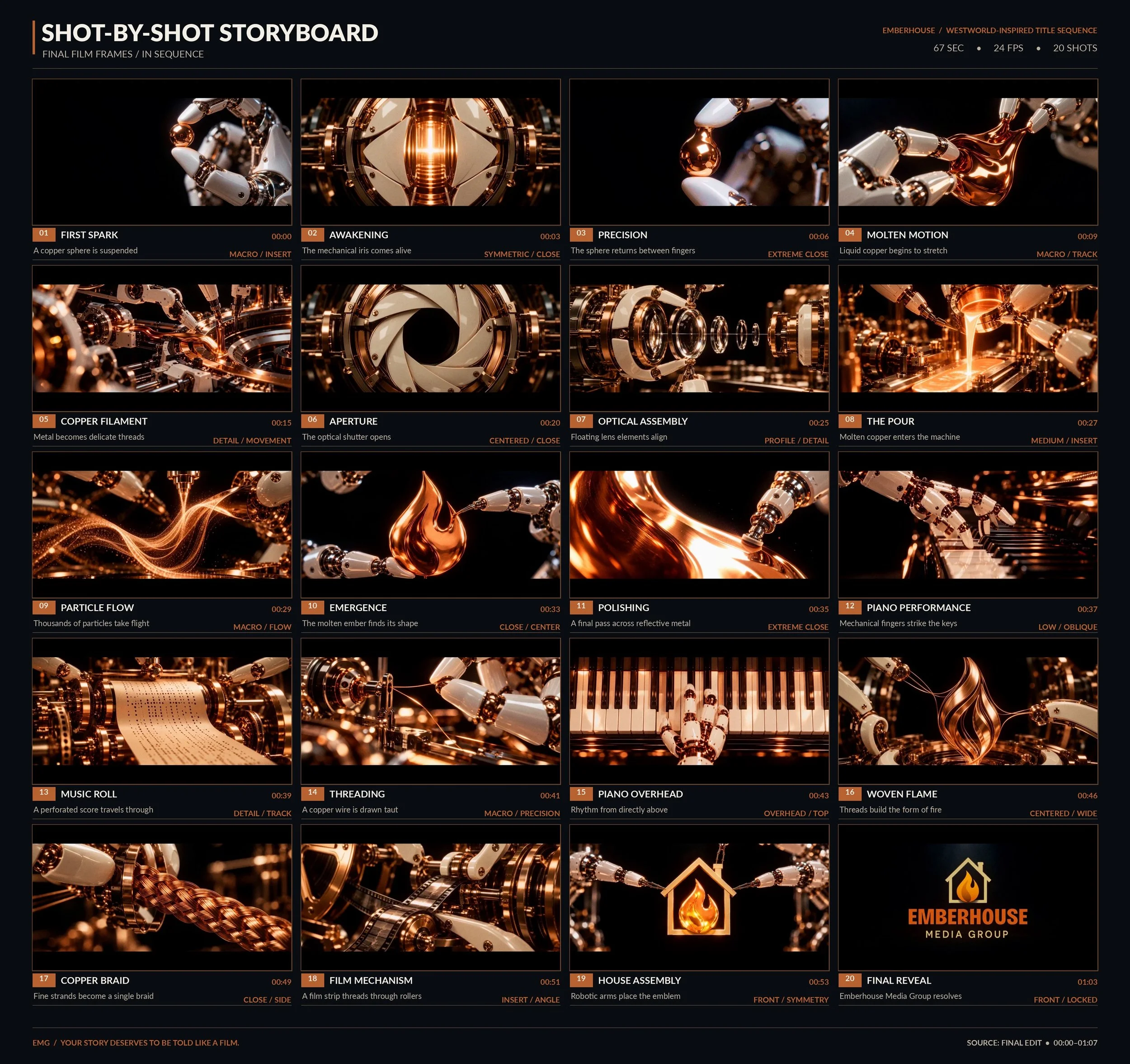
Mechanical hands manipulate copper spheres. Intricate machines weave metallic strands. Robotic fingers play a piano while optical elements, film mechanisms, and molten materials move through their own sequences.
Each composition was designed with cinematographic principles in mind.
Lighting, depth of field, camera perspective, framing, and movement were considered throughout the visual development process.
The goal was to make the images feel as though they belonged to the same cinematic world, despite being created as separate elements.
Building the World:
Creating individual images was only the beginning. The challenge was making them work together as a film.
AI-assisted image generation provided the foundation for the project's visual development.
Individual frames were created and refined before being used as references for video generation.
This approach allowed us to experiment with compositions, mechanical details, materials, and camera angles before committing to the animated sequences.
But generating movement introduced another challenge.
Objects needed to maintain their appearance. Mechanical components needed to move convincingly. Camera movement had to feel deliberate rather than arbitrary.
Not every generation produced a usable result.
The process required evaluating the footage, refining individual shots, and selecting the versions that best supported the overall sequence.
The technology helped create the imagery. The creative decisions determined how those images became a film.
Bringing Everything Together:
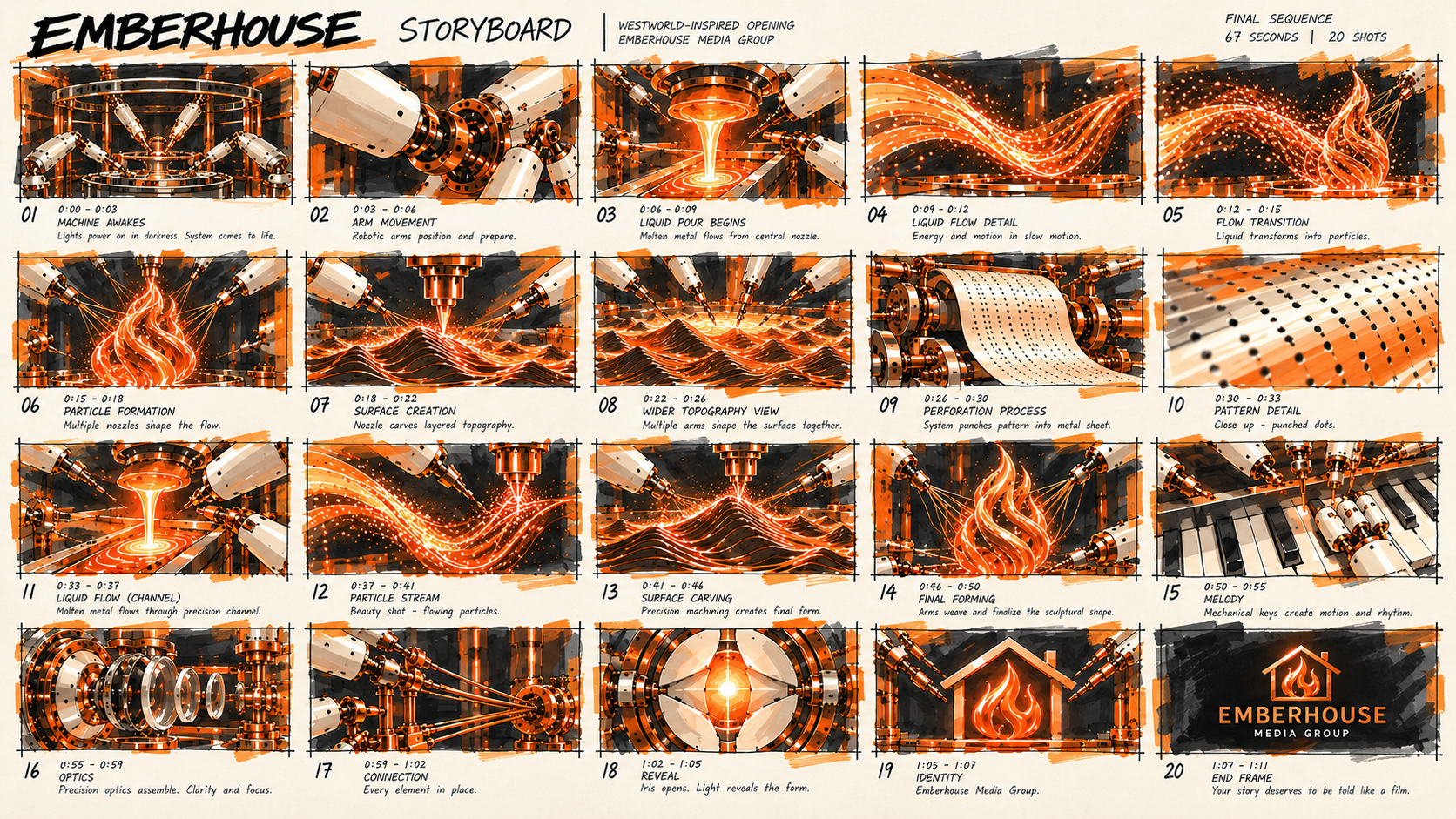
The final sequence was built in DaVinci Resolve Studio, where the individual scenes became part of a larger visual narrative.
Rather than treating the project as a collection of impressive images, the edit was designed around pacing, visual progression, and music.
Close-up mechanical details were contrasted with wider compositions, allowing the sequence to move between intimate moments and larger industrial environments.
Musical phrasing helped guide the rhythm of the edit, while the progression of imagery gradually built toward the final reveal.
The challenge was giving each shot enough time to establish its visual identity without losing the momentum of the overall film.
By the end of the sequence, the individual elements converge around the Emberhouse house-and-flame symbol.
What began as a series of seemingly unrelated mechanical processes ultimately resolves into a single recognizable identity.
Exploring What Comes Next:
The project was never intended to demonstrate that artificial intelligence could replace traditional filmmaking.
It was an opportunity to explore how new tools could expand the possibilities available to filmmakers.
The images were generated rather than photographed on a physical set, but the underlying creative considerations remained familiar.
Composition still mattered.
Lighting still mattered.
Camera movement still mattered.
Editing and musical timing still mattered.
Most importantly, every shot still needed a reason to exist.
For Emberhouse, this experiment reinforced something central to our approach to production:
The tools used to create an image are only part of the process. The decisions behind that image are what give it purpose.
The final 67-second sequence transformed a simple logo reveal into an exercise in visual storytelling, creative direction, and cinematic experimentation.
The Final Film:
“I wanted to see what would happen if we treated a simple logo reveal like the opening of a prestige television series. Sixty-seven seconds later, I think we proved that even the smallest story can deserve a cinematic approach.”
Forrest McBride
Co-Founder | Director of Photography
Emberhouse Media Group